
No products in the cart.: R 0.00


If you have been doing lashes for a few years and the thought of teaching has crossed your mind, you have probably also wondered whether there is actually money in it. Not the Instagram version of it. The real version, in South Africa, with real students, realistic class sizes and no audience yet.
The short answer is yes. Definitively. But the longer answer is worth reading, because how you set it up matters more than whether you do it. This guide covers real income figures, what startup costs actually look like, and what your first year as a lash trainer in South Africa can realistically look like.
What lash training actually pays
A lash training class runs over two to three days depending on what you are certifying students in. Classic lash extensions covers two days. If you add Russian Volume, that is a third day, and most trainers charge per student for the full programme.
Here is what a single training session realistically earns, based on conservative pricing for a non-affluent area. Your numbers may be higher depending on where you are based and what you charge.
Classic lash training (2 day class)
| Students | Estimated profit |
|---|---|
| 4 students | R15 072 |
| 3 students | R11 304 |
| 2 students | R7 536 |
| 1 student | R3 768 |
Classic and Volume training (3 day class)
| Students | Estimated profit |
|---|---|
| 4 students | R28 468 |
| 3 students | R21 351 |
| 2 students | R14 234 |
| 1 student | R7 117 |
These are conservative estimates based on non-affluent area pricing. Your numbers may differ.
One Classic and Volume training day with four students returns R28 468. Compare that to a full week behind the bed doing lash sets. For most lash artists, training once a month covers what used to take four weeks of client work.
Is there actually demand in South Africa?
Yes, and it is growing. The lash industry in SA has expanded significantly over the last decade. Beauty therapists, nail technicians, hairdressers and complete newcomers are all looking to add lash extensions as a service. The demand for qualified, credible trainers is real, and the supply of truly professional, internationally accredited educators is still relatively limited.
The keyword here is accredited. Students are increasingly savvy about what they are paying for. A certificate from a trainer with no verifiable international credentials is worth less than it used to be. Trainers who can point to a recognised accreditation body, like Lash Inc UK, are in a stronger position than those who cannot.
Another factor worth noting: most people searching for how to become a lash trainer in South Africa are already working lash artists. They are not looking for a theory course. They want a practical, complete system they can implement immediately. That is where a properly structured educator programme earns its value.
What are the startup costs?
This is the question most aspiring lash trainers quietly worry about but rarely ask out loud. The honest answer is that the startup costs are lower than you probably think, for one simple reason: you already have most of what you need.
If you are an established lash artist, you already have a workspace. You have tools and equipment. You have a client base that can become a word-of-mouth network. What you do not have yet is the curriculum, the documentation, the grading framework and the internationally recognised credential that makes you a legitimate trainer rather than just an experienced lash artist who teaches informally.
The main upfront cost is your educator certification. At LBI, the Classic and Volume Combo educator certification is R22 500. That covers the full 12-module programme, your Lash Inc UK accreditation pathway, a complete ready-to-brand curriculum editable in Canva, student grading systems, contracts, waivers, and everything else you need to run a professional training day from the start.
Here is what the return on that investment looks like in practice. A Classic and Volume training day with just two students returns R14 234. With three students it is R21 351. Most LBI graduates recover their full course investment within two to three training sessions. After that, every class is profit.
You do not need a separate training studio. Starting in your own salon on off days keeps your overhead at zero. No lease, no additional equipment, no staff. The margin on lash training is significantly higher than the margin on doing lash sets, precisely because the only real input is your knowledge and time.
What does year one actually look like?
This is the part most educator courses skip over, which is frustrating because it is exactly what every aspiring trainer needs to know before they commit. Here is a realistic picture of what your first year as a lash trainer in South Africa can look like, based on starting small and building steadily.
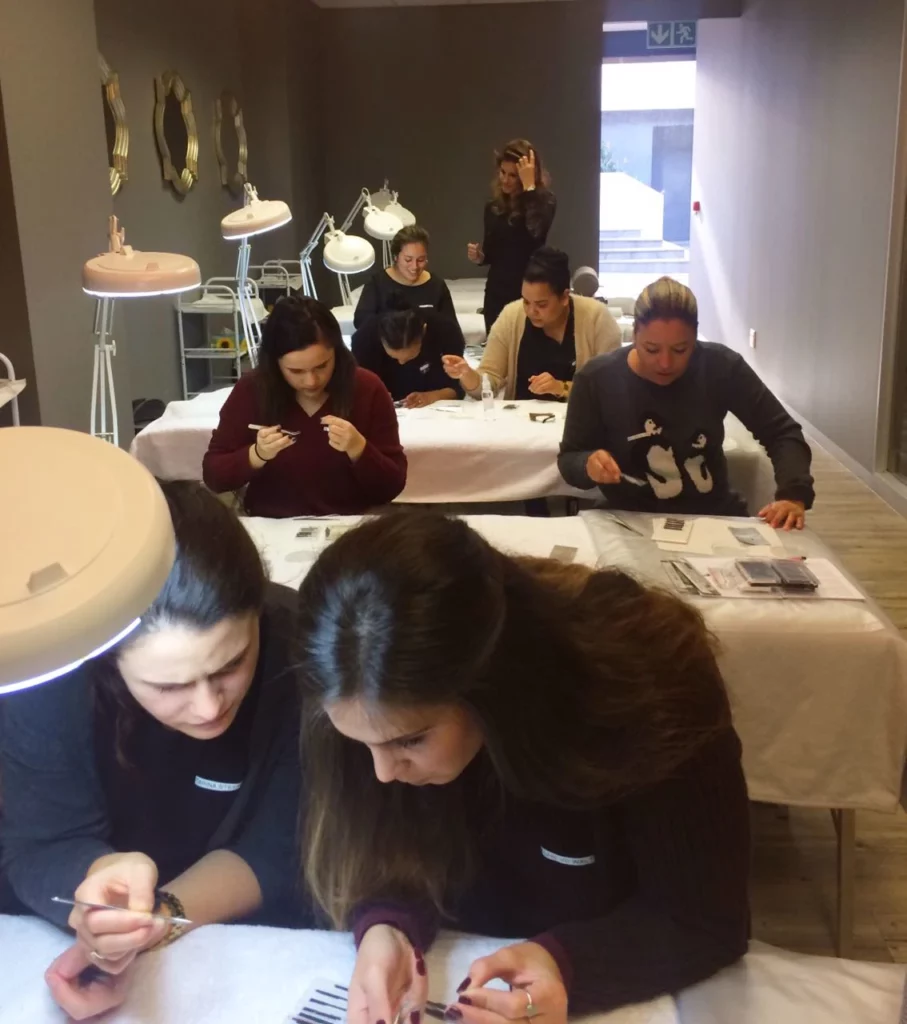
A full training class in session at my salon, The Urban Beauty Lounge. We used the lash beds as “desks” for the theory and practical prep components, then converted them to treatment beds for the hands-on sessions. No separate training facility needed.
Months 1 and 2
You complete your educator certification. You run your first class, likely with one or two students, possibly people from your existing network or lash client base. You refine your delivery, gather your first reviews and start building the word-of-mouth foundation.
Months 3 and 4
You run one class per month. Your reviews are in and visible. Students are starting to find you through Google searches and social media. Your course investment is recovered. Every class from here is income.
Months 5 to 8
Word of mouth is working. You are fielding enquiries without actively hunting for students. You may start running classes more frequently as demand grows. Your lash client work reduces in proportion to your training income.
Month 8 and beyond
You have a functioning lash training business running alongside or instead of your client work. Your income is more predictable. You are working fewer hours for comparable or greater earnings.
This is not a guaranteed timeline. It depends on your consistency, your location and how seriously you approach the business side of training. But it is a realistic one for a lash artist who starts with the right foundation and treats it as a proper business from day one.
What actually makes it work
Training is viable when you treat it like a business from the start, not a side project. The trainers who struggle are usually the ones who run one class, get a few students, then wait for the phone to ring. The ones who build a real income stream are the ones who systemise it early.
That means having a proper curriculum students can follow and keep. A grading system that protects you legally. Documentation that looks professional from day one. A way to find students consistently before word of mouth kicks in on its own.
It also means starting smaller than you think you need to. One class a month in your existing salon space with two or three students is a perfectly reasonable start. You do not need a separate training facility. You do not need a large following. You need a solid programme and a credential that holds up.
The bottom line
Yes, lash training is a viable income stream in South Africa. It pays well, it scales without hiring staff, it uses a skill you already have and the demand is there. The barrier for most lash artists is not the market. It is having the right framework to start confidently.
If you are seriously considering how to become a lash trainer in South Africa, the LBI Lash Educator certification is built exactly for this. It gives you the curriculum, the accreditation, the business framework and the practical tools to run your first class professionally. Full details are on the course page.
